From Kashmir to the Gulf majlis
The story of the shal, from the pastures of Ladakh and the needles of Kashmir to men's heads in the Gulf winter, as told by its own people and records. Every sentence here cites a source listed at the end of the page.
Covering the head
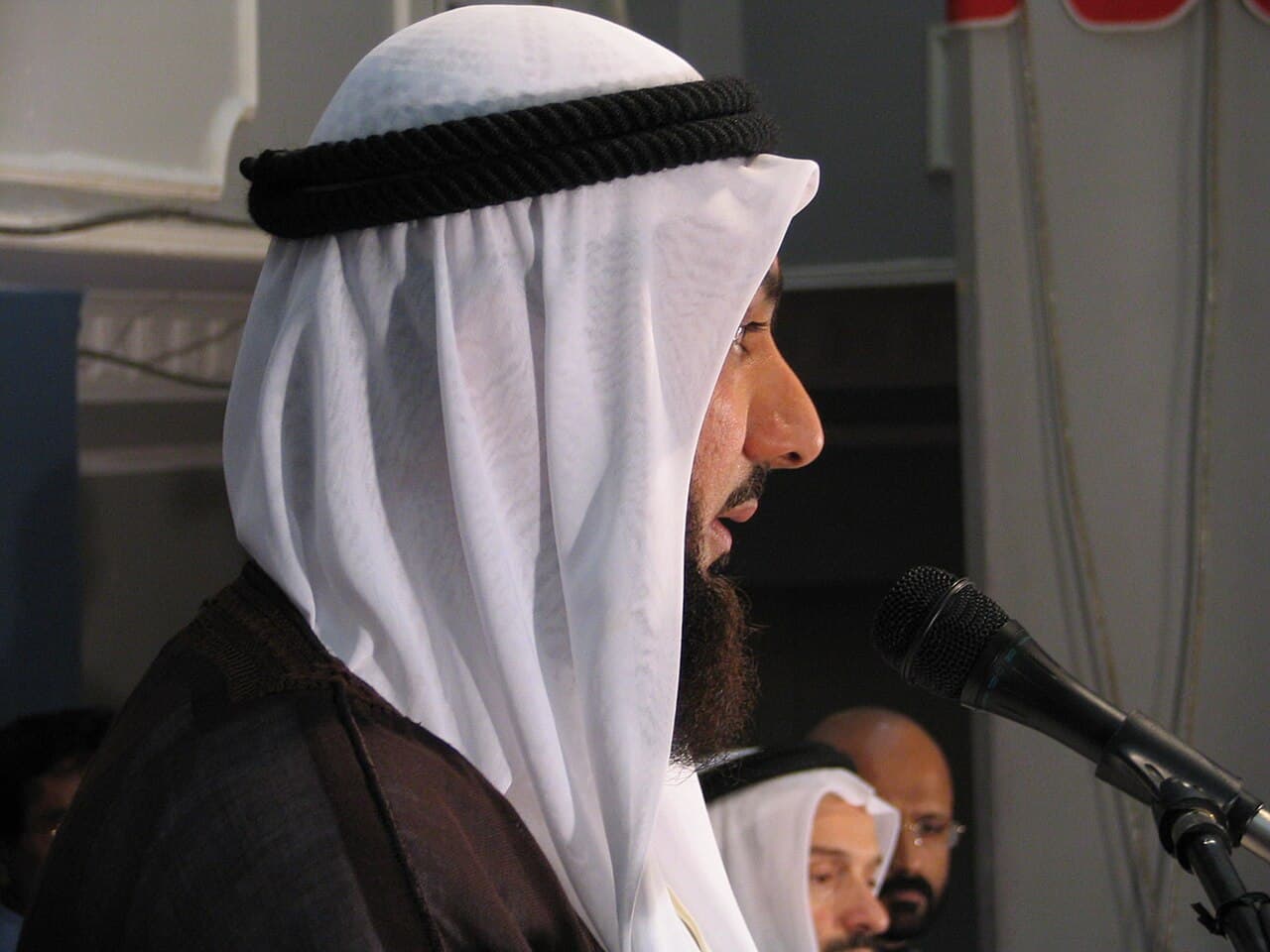
The taqiyah is the cap worn under the shemagh or ghutra; its plural is tawaqi. Its name is said to come from protection, because it shields the head from heat, sun and sweat.[1]
In the Emirates it is known as the jahfiya: a white, openwork cap worn under the ghutra, and one of the essentials of Emirati dress.[14]
It is also called the qahfiya. The Qatari architect Ibrahim Al-Jaidah drew the design of Al Thumama Stadium for the 2022 World Cup from the shape of the traditional white qahfiya, with its threads and openings, because it is a cultural element shared across the Arab countries.[15]
The ghutra is a white piece of lightweight cotton; the shemagh carries red squares. Both are folded into a triangle and worn with the thobe and the black agal.[2]
In the First Saudi State, many men wore the shemagh or ghutra with the agal, while some scholars and Bedouin wore turbans.[5]
The shemagh has been the most common head covering in the Kingdom since the mid-1970s.[2]
In Kuwait, Bahrain and the Emirates, the white ghutra and agal complete a man's dress; for a Saudi man, the thobe is not complete without the red shemagh.[9]
The agal
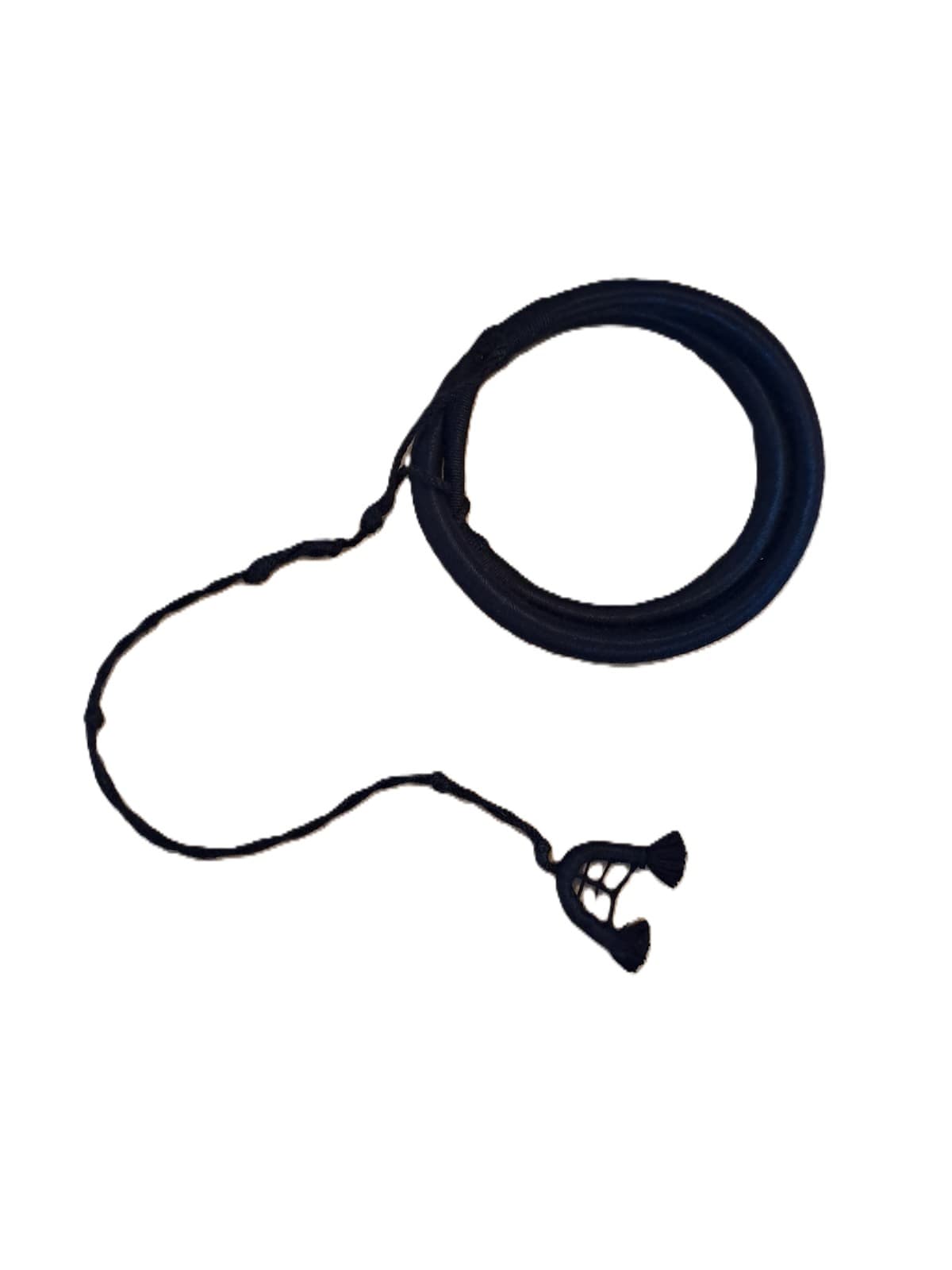
The agal is the ring worn over the shemagh or ghutra. Its name may come from the way Arabs used it to tie and restrain camels.[4]
Its size and material have evolved over three centuries, and older agals were much thicker than those made today.[3][4]
The finest material is black goat hair, known as al-mar'az. One kind, al-Muqassab, is popularly called the kings' agal because three Saudi kings wore it: King Abdulaziz, King Saud and King Faisal. It is made of camel hair, light brown or white, with two hanging threads.[3]
In Qatar, the agal is marked by its long cord, from which the karkoosha hangs.[9]
The shal
In the glossary of clothing names published by Saudipedia, the shal is “a woollen cloth they wore on their heads in winter for warmth”. Its plural is shilan.[1]
There are also patterned yellow or white ghutras, typically worn in winter.[2]
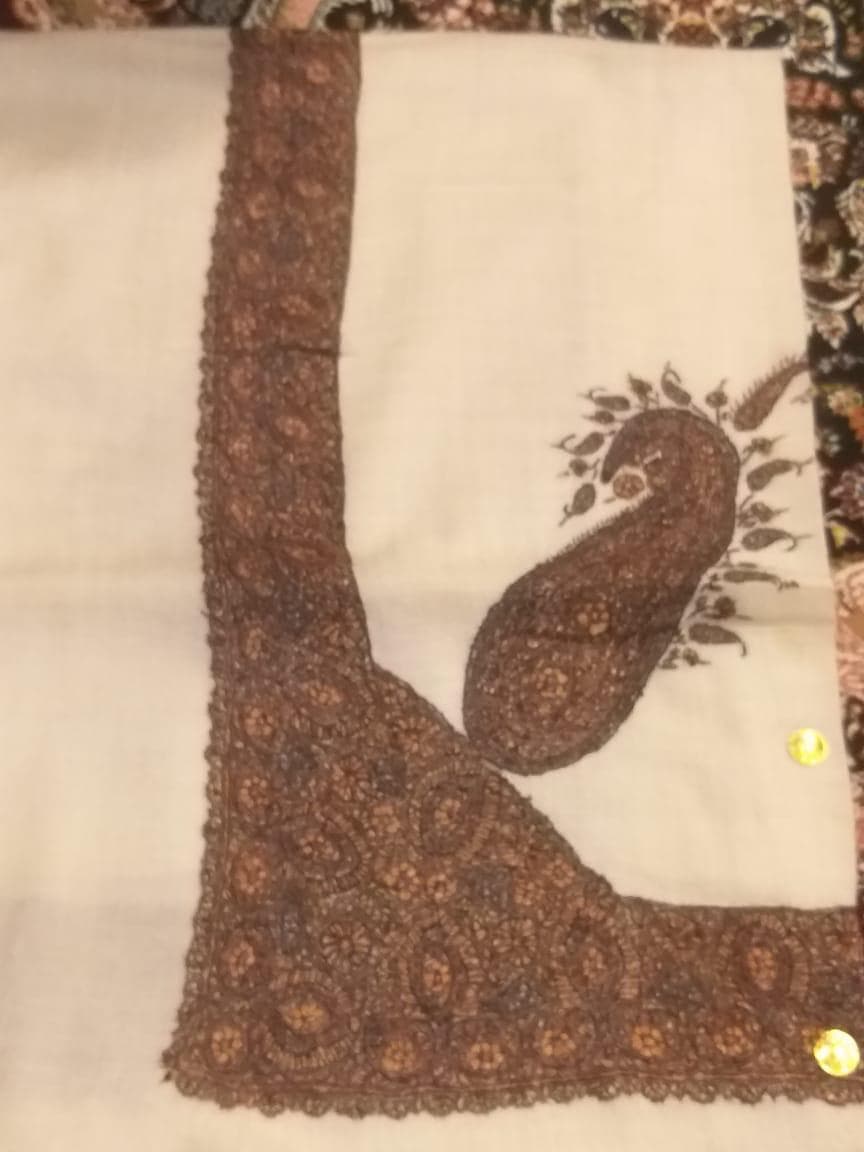
In the Emirates, the heavy wool ghutra worn in winter is called the shal. Khalid bin Youssef describes it as a little larger than the white ghutra in width and length, usually graded brown or black, with dark embroidery.[6]
Bin Youssef recalls that the shal was once a luxury because of its high price, so most men made do with a single shemagh for the whole winter, and that the cold was harsher when there were fewer buildings and settlements.[6]
People of the desert and the hunt need it, because they spend long nights out in the sand.[6]
Bin Youssef notes that Qataris choose broad embroidery, while Emiratis prefer a narrow line.[6]
The Kashmiri shawl, made of fine goat hair, is well known across the Gulf and is imported from Kashmir. One rare kind, known as “Abu al-Mithqal”, used to be sold by weight. Well-off families dressed their children in the shal in winter.[7]
Pashmina
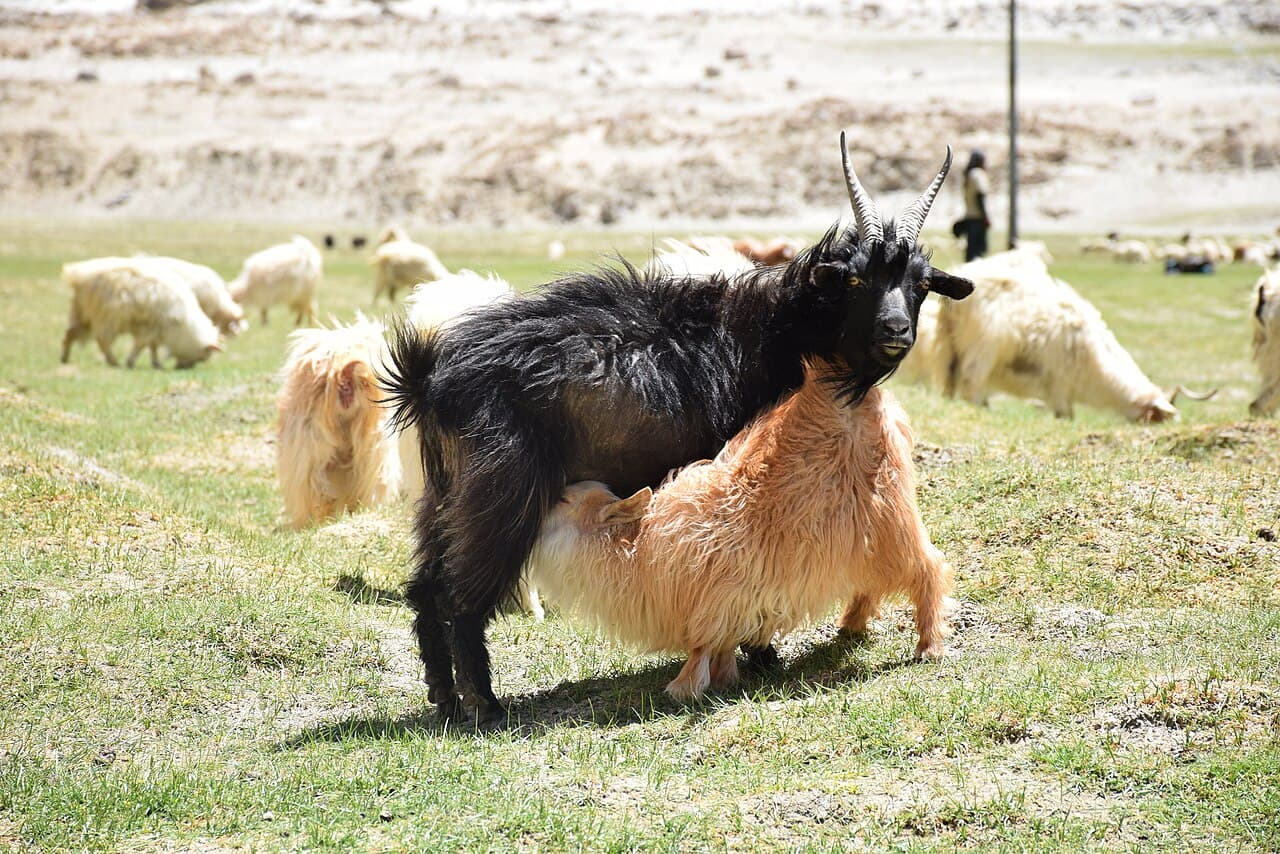
On the Changthang plateau of Ladakh, between 3,000 and 6,000 metres above sea level, lives a goat breed called Changthangi. It is herded by the Changpa, a nomadic tribe. In winter the temperature there drops to −50°C.[10]
The goat's long hair guards it against the extreme cold. Beneath it grows a soft undercoat called pashmina.[10]
The word comes from pashm, Persian for wool.[13]
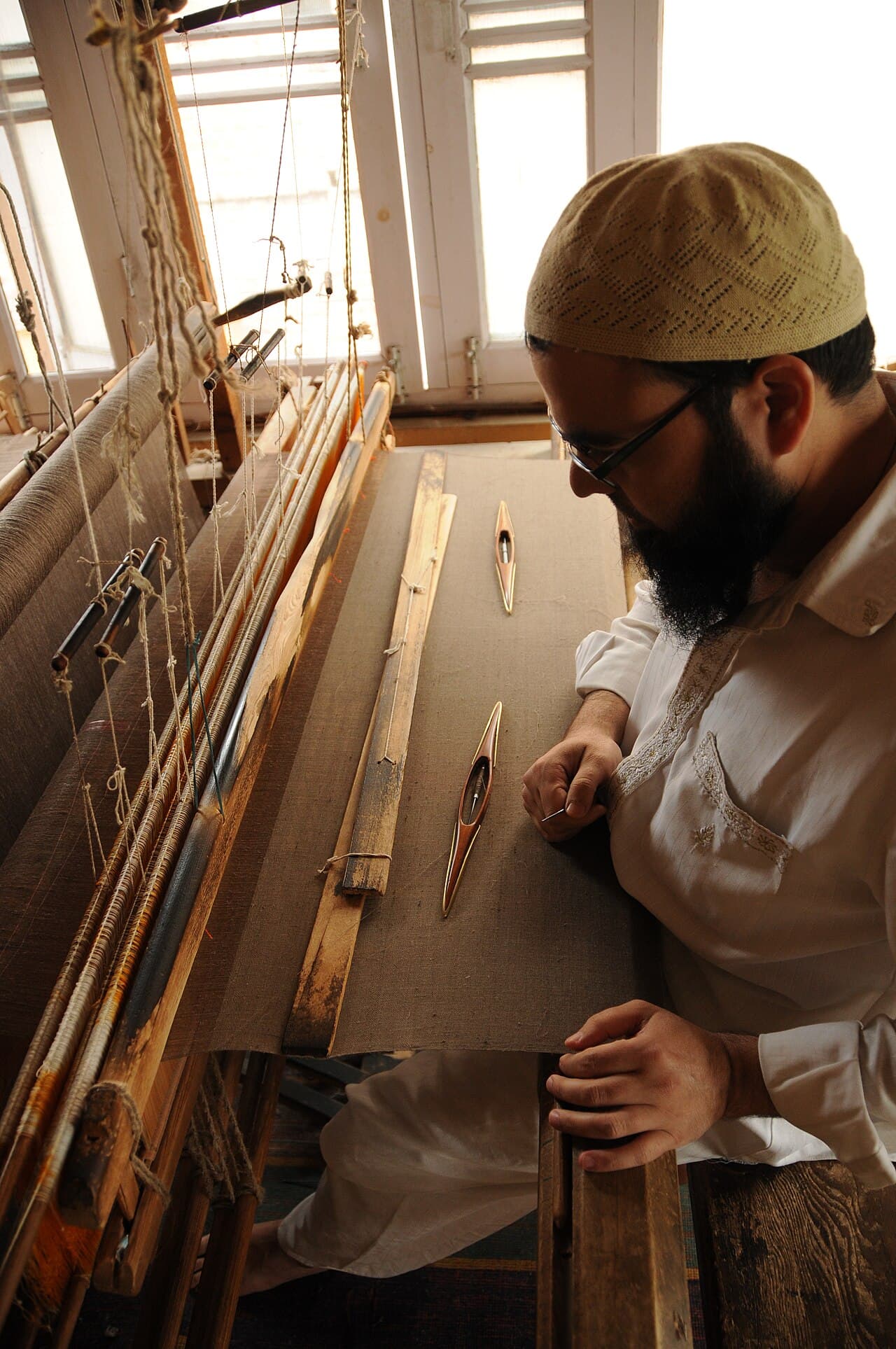
In spring, when the goats shed their undercoat, the herders collect it by brushing, not shearing, mostly from the neck. The raw wool is sold in the markets of Leh, and middlemen carry it to Srinagar, where pashmina weavers buy it.[13]
The hair is washed of grease, dust and coarse hair, then spun.[8]
The emperor's shawl
The Ain-i-Akbari of Abu'l-Fazl, from the reign of the Mughal emperor Akbar, has a chapter titled “On Shawls, Stuffs, &c.”[12]
Abu'l-Fazl writes that Akbar “prefers and wears woollen stuffs, especially shawls”, and that he gave the shawl a new name, parmnarm.[12]
“In former times shawls were often brought from Kashmir. People folded them up in four folds, and wore them for a very long time.” Akbar, he adds, “encourages, in every possible way, the manufacture of shawls in Kashmir.”[12]
Sozni
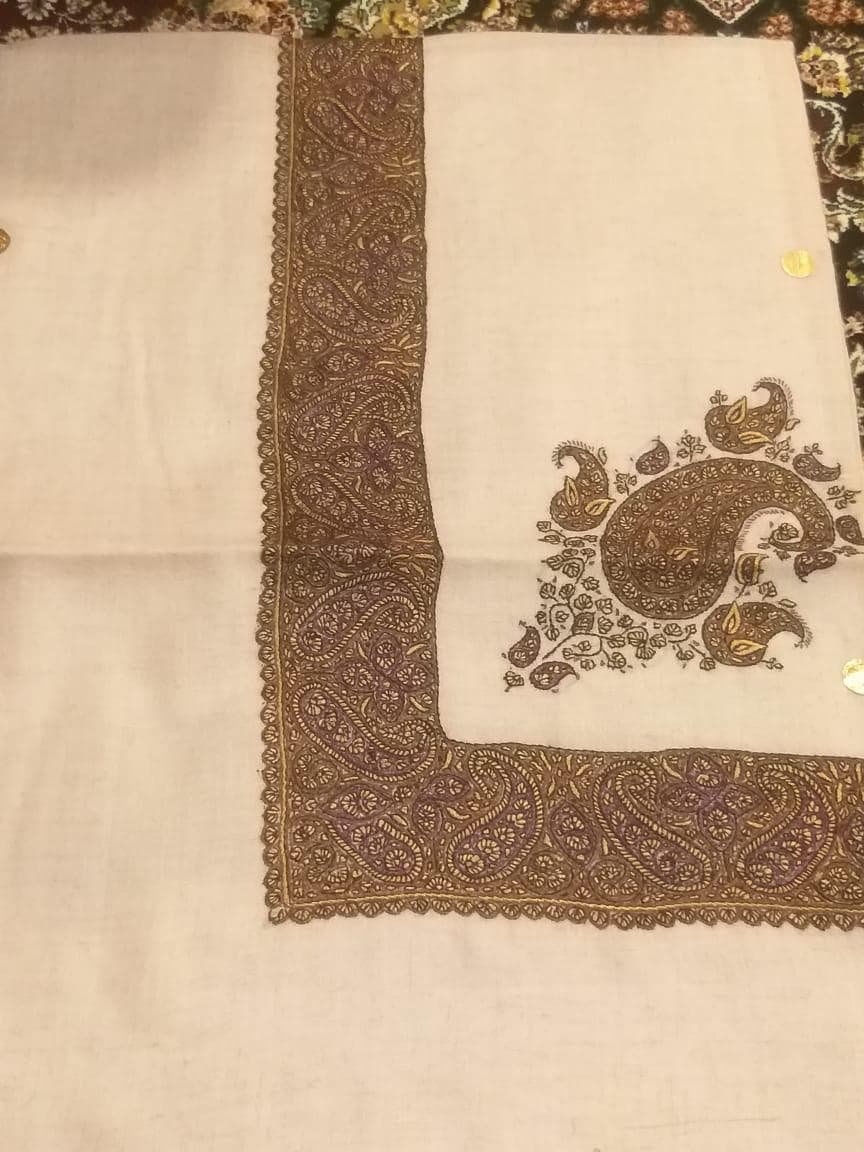
Sozni is fine needlework on cloth, done by an artisan called a sozankar, mainly in the sozani stitch, the dam stitch and the stem stitch, with silk and viscose yarn.[11]
The sozani stitch is a fine couching stitch, with a reinforcing stitch laid over a base stitch, and it gives the embroidery uniformity on both sides of the cloth.[11]
Before the needle, a naqash draws the design on graph paper. A carver cuts a block of walnut wood, which is dipped in washable ink and stamped on the shawl. A tarah-guru then embroiders a sample and decides the colours, and only then does the artisan receive the piece to complete the embroidery by hand.[13]
The most dominant motif in sozni is the buti, a floral or almond motif with a bent tip. Others include the chinar leaf, cypress, almond, grapes, pomegranates and cotton seeds, and flowers such as iris, narcissus and lotus.[11]
The GI document also describes the kunj: “a large sized Almond motif that is placed on the corner of the fabric facing towards the centre.” It is the motif you see in the corner of most of our pieces.[11]
Sources
We relied on Saudi Arabia's official encyclopedia, the Gulf press, official and scholarly Indian references, and the original text of the Ain-i-Akbari.
- 1Saudipedia, “Colloquial names of clothing in Saudi Arabia”
- 2Saudipedia, “What Is the Difference Between Shemagh and Ghutra?”
- 3Saudipedia, “Al-Egal”
- 4Saudipedia, “Al-Egal Craftsmanship in Saudi Arabia”
- 5Saudipedia, “Social Life in the First Saudi State”
- 6Al-Etihad (Abu Dhabi), “The Emirati shawl…”, 1 January 2011
- 7Al-Etihad, “The shawl adorns men's heads in the winter months”, 6 January 2012
- 8Al-Etihad, Hana Al Hammadi, “The Kashmiri shawl at the Sheikh Zayed Festival”, 6 January 2021
- 9Al-Wasat (Bahrain), Ali Abu Hamad, “What do you know about the Gulf thobe?”, 2016
- 10Mishra P. et al., “Breed characteristics and genetic variability in Changthangi goats”, Indian Journal of Animal Sciences 80(12):1203–09, 2010 (ICAR–NBAGR)
- 11Craft Development Institute, Srinagar, GI application “Sozani Kashmir”, Geographical Indications Registry, Chennai
- 12Abu'l-Fazl, Ain-i-Akbari, Vol. I, trans. H. Blochmann, Asiatic Society of Bengal, 1873, Ain 32
- 13Sahapedia, Danish Qazi, “Essence of Kashmiri Craftsmanship: Sozni and Kani Work on Pashmina”
- 14Al-Bayan (Dubai), Aisha Abdullah Al-Muhairi, “Traditional men's dress: the dignity of simplicity”
- 15Al Jazeera Net, “Al Thumama Stadium, an architectural icon inspired by Arab heritage”, 7 October 2022